
The Vanguard Isolator™ is Quantum’s patented structural isolation sub. Where traditional gap subs achieve electrical isolation by introducing a mechanical weakness, Vanguard builds isolation directly into a high-torque, fatigue-resistant connection. Torque capacity that exceeds the highest-rated Extreme Torque API end connections. 29 million feet drilled. Zero failures. And the only architecture strong enough to run two isolators in a single BHA — the foundation of the Quantum Leap™ inter-BHA hop.

The story starts with failure. Quantum’s original (Alpha) gap sub had a stretch of six downhole failures over ~4,585,000 ft in two years. We had a choice: ship more Alpha or rebuild it. We rebuilt it. Analysis traced the failures to three things — isolation, load path, and material — and we redesigned each one from the threads outward. The Vanguard architecture shipped, and the result has been staggering.
The industry doesn’t need a better gap sub. It needs a different approach to isolation.
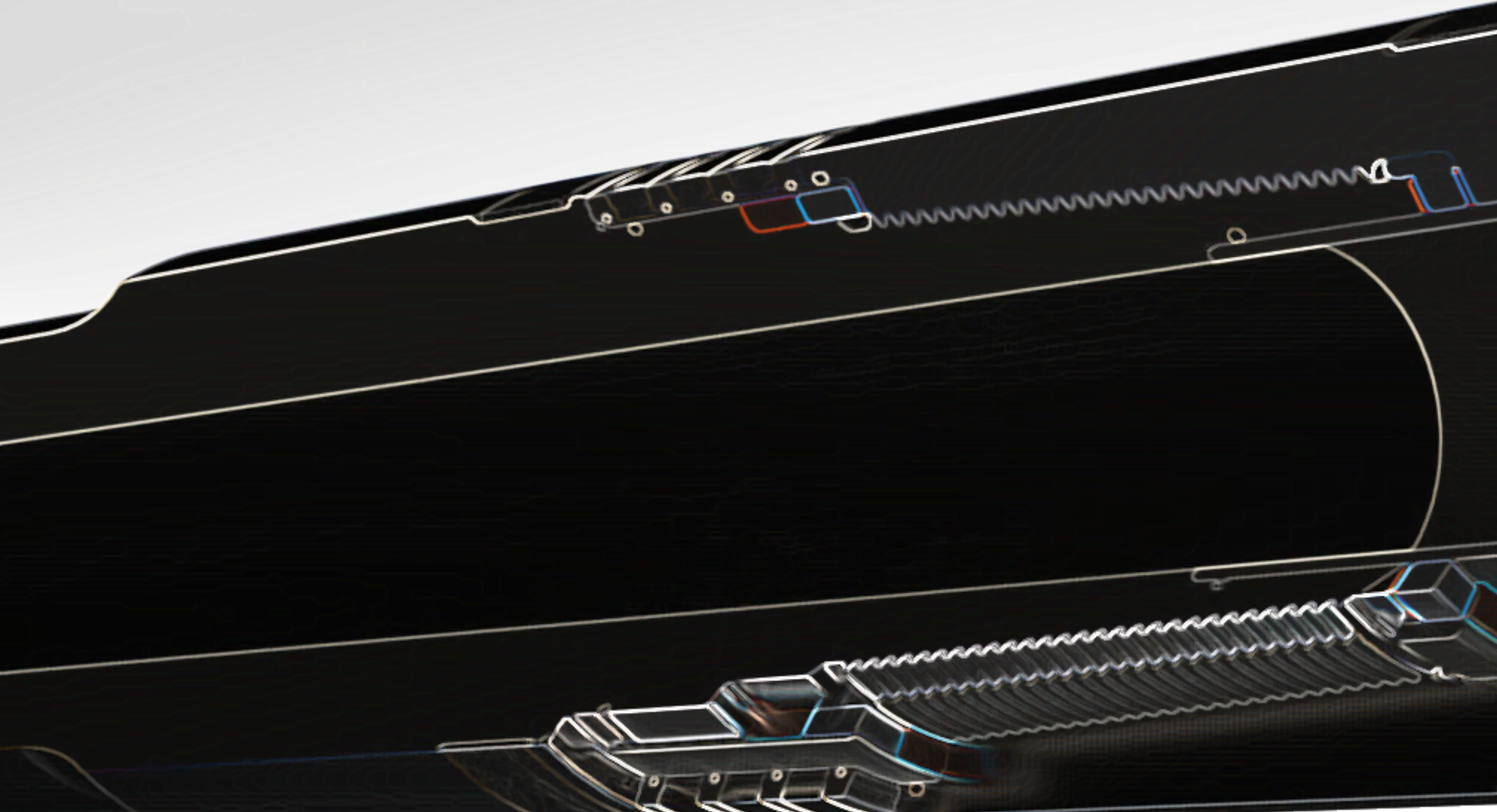
VIC™ is Quantum’s patented, fatigue-resistant, high-torque structural threaded connection — a multi-load-path architecture optimized for torque, bending, and axial loads.
No voids. No pockets. Extreme torque. The dielectric loads hydrostatically and carries torque the way conventional polymer-filled joints cannot. Radial interference between the sleeve and the mating threads engages before the shoulders contact, adding torque capacity ahead of shouldering.
Built around the proprietary VIC threaded connection plus an ultra-high-strength nitrogen-strengthened alloy in a double-shouldered configuration, Vanguard Isolator delivers electrical isolation without the structural weaknesses of traditional gap subs — even in high-dogleg, high-torque, extended-reach environments.
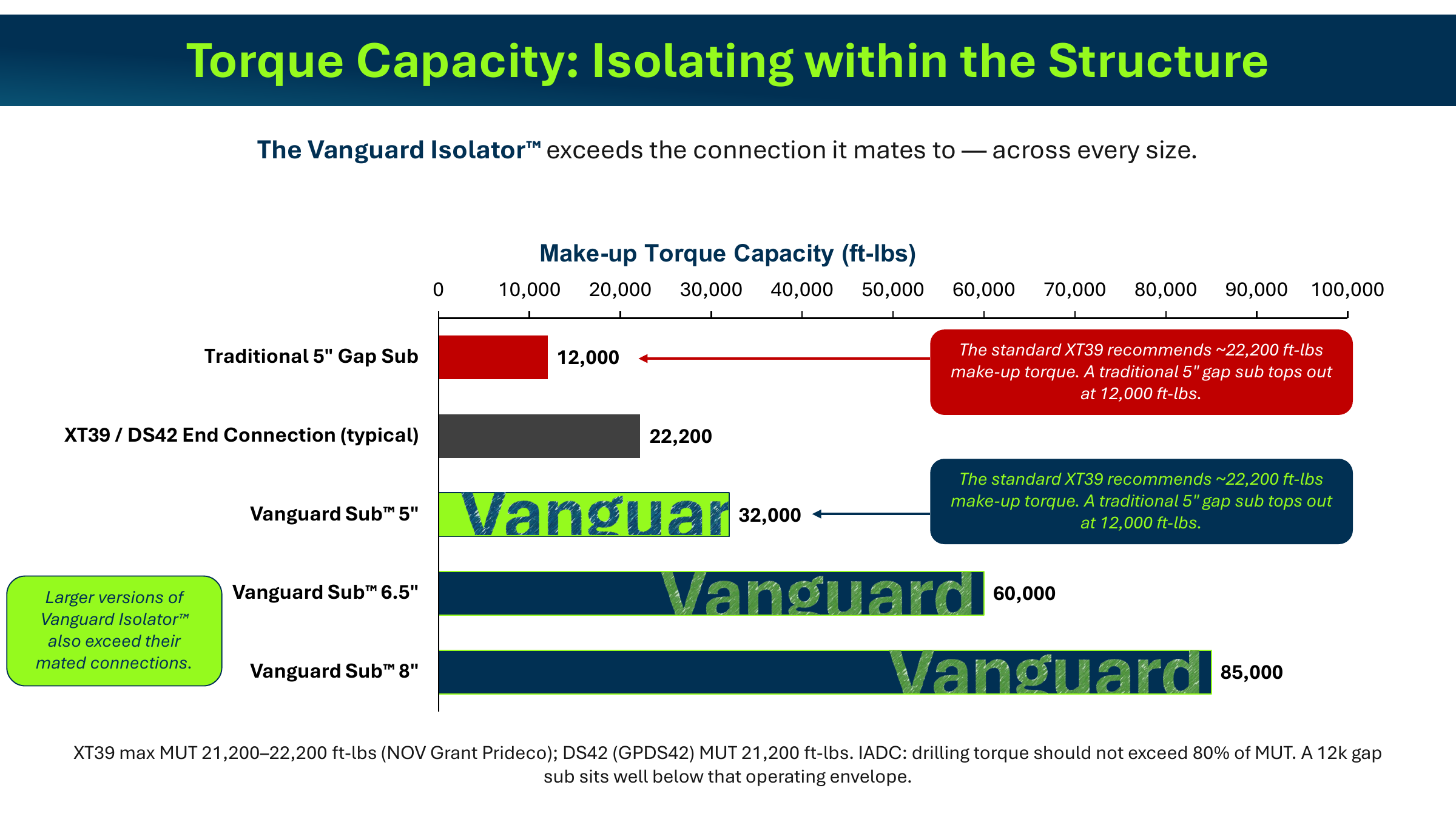
The XT39 / DS42 family are the highest-rated Extreme Torque API end connections in the industry. They recommend ~22,200 ft-lbs make-up torque. A traditional 5″ gap sub tops out at 12,000 ft-lbs — the BHA’s weakest connection by design. Vanguard exceeds the connection it mates to on every size.
The Vanguard architecture is protected by two patent applications. Together they retire the traditional gap-sub trade-off — you no longer choose between strength and signal.
An insulator sleeve fills the entire volume between pin and box. No voids. No pockets. The dielectric is loaded hydrostatically — pressure on every face — so it carries torque without yielding the way conventional polymer-filled joints do.
Radial interference between the sleeve and the mating threads engages before the double-shoulders contact, adding torque capacity ahead of shouldering.
Alternating dielectric and nitrogen-strengthened non-magnetic spacer rings sit on a non-conductive seal sleeve. Every dielectric ring’s inner diameter seals out drilling fluid.
The design forces leakage current to “hop” across many high-impedance interfaces, pushing EM field lines outward into the formation rather than back across the joint.
Strength on the inside. Signal on the outside. You no longer pick one.
The BHA spec barely changes — except where it has to. Vanguard drops directly into existing BHA designs with standard API connections, standard make-up procedure, and no rig-floor retraining. Ask your EM provider the internal make-up torque limit of their gap — get ready for a surprise.
Drops directly into existing BHA designs. Standard API connections, standard make-up procedure, no rig-floor retraining required.
Vanguard exceeds end-connection make-up torque on every size. Adjacent subs and collars run at their full rated torque and bending capacity.
No 12,000 ft-lb gap-sub limit for the driller to manage. No special torque turn-downs through curves or while reaming. Run it like any other connection.
Spec it like a connection. Run it like a connection. Because that’s what it is.
Every traditional gap-sub failure traces back to one of four root causes — and they all share a deeper root: isolation built with a gap. Vanguard builds isolation into the connection, and removes them.
Load-bearing polymer carries the joint torque. Capacity capped around 12,000 ft-lbs (5″) — the BHA’s weakest connection.
32,000 ft-lbs (5″) / 60,000+ (6.5″) / 85,000 (8″). Exceeds end-connection MUT on every size.
Standard alloys plus a discontinuity at the gap initiate cracks in high-DLS, extended-reach, and high-torque sections.
Custom (non-API) thread profile spreads load across more of the connection. Nitrogen-strengthened ultra-high-strength steel. No designed-in stress riser.
Drilling fluid weeps into hairline cracks in the polymer or Kevlar fill, shorts the isolation, and kills EM telemetry mid-run.
Full-volume PEEK sleeve, void-free thread form. Sealed by geometry, not by adhesive. External ring stack adds maximum isolation.
When polymer or composite filler is the structural element, sustained downhole temperature and cyclic loading drive it toward yield.
Hydrostatic loading — dielectric can’t yield. Pressure on every face. No voids to deform into. Unaffected by bottom-hole temperature or run hours.
The Quantum Leap™ inter-BHA wireless hop runs two Vanguard Isolators in a single BHA — one above the RSS, one below — so the comms link spans the rotary-steerable without a wired sub. Traditional gap subs can’t do this. A 12,000 ft-lb torque ceiling stacked twice in the same string is a non-starter for any high-torque, extended-reach run. Vanguard’s structural-connection torque is what makes the double-isolator stack viable.
Both isolators run at full Vanguard torque capacity. Neither becomes the weakest link in the string.
Leap’s hop carries comms across the rotary-steerable section — the part of the string a wired link can’t cross.
The 30-ft Vanguard variant with twin extended flex sections runs in motor-assisted RSS BHAs — better curve yield, fewer connection failures.
The hop is only possible because the isolator is strong enough to be doubled. No gap sub can be doubled. That’s the moat.
Four 6.625″ Vanguard architectures were exposed to a dogleg severity their spec sheet says they shouldn’t survive. The procedure said retire them. The teardown said otherwise.
Cracking, telemetry loss, or twist-off in the curve. Almost certain structural failure.
Complete teardown — all internal components passed visual inspection. Upper and lower subs passed visual and dye-penetrant. No cracks. Subs DBR’d per procedure — pulled out of service because of spec exposure, not structural failure.
Procedure said retire them. Physics said they held. That’s a structural connection — not a gap.
Stabil Drill licensed a 30 ft variant of the Vanguard Isolator with twin extended flex sections — a non-magnetic drill collar that combines the patented VIC connection with the flex geometry their motor-assisted RSS BHAs call for.
Better curve yield. Fewer connection failures in motor-assisted RSS BHAs. The variant pairs the same Vanguard Isolator torque rating with extended bend tolerance — so the curve-section weak link stops being the curve-section weak link.

MESH™ telemetry. The full Quantum Leap™ inter-BHA hop family. BitView™’s at-bit resistance. Every Quantum product that depends on driving EM current into the formation runs through the VIC. Plus the 30-ft Vanguard variant with twin extended flex sections — better curve yield, fewer connection failures in motor-assisted RSS BHAs.
Where electrical isolation meets structural integrity. Foundation of MESH, Leap, and BitView™.