Downhole comms aren't limited by distance — they're limited by environment. Cathodic protection on adjacent pipelines, surface industrial noise, and changing formation impedance all attack the signal. Quantum Spectrum™ is the layer that monitors, filters, and adapts the EM signal in real time so comms hold up where they used to drop.
Identifies and suppresses external electrical interference before it ever reaches the decoder.
Continuously improves signal-to-noise ratio. The link adapts as the noise floor changes underfoot.
Maintains stable communication where conventional EM decoders give up.
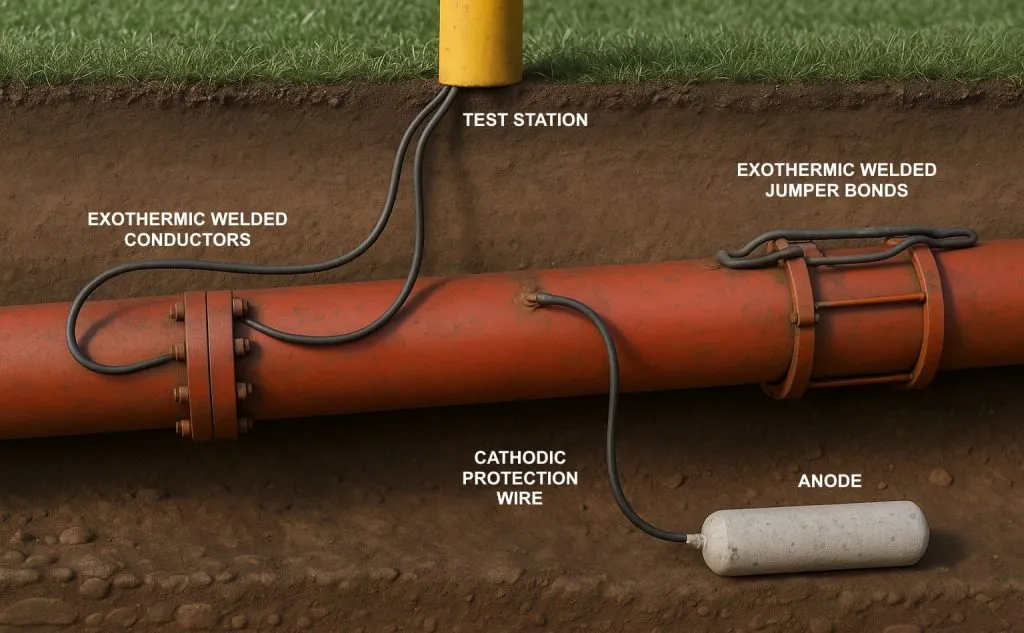
Mature fields are blanketed in cathodic-protection systems that inject low-frequency current into the ground to slow pipeline corrosion. That CP current sits squarely in the EM telemetry band and historically meant EM telemetry didn't work in those fields. Spectrum changes that.
Critical for mature fields with extensive pipeline networks — the wells competitors said couldn't be run on EM.
A Quantum MWD doesn’t pick the best receive antenna and hope it’s clean. Spectrum™ takes everything it’s hearing — every receive antenna, the live noise environment, the signal characteristics it knows the downhole transmitter is sending — and uses that intelligence to construct an entirely new channel: a synthesized stream purpose-built for one job — decoding this transmission, in these conditions, right now.
That virtual channel isn’t tied to any single antenna and isn’t a fixed mix. It’s a new signal, computed in real time, optimized for maximum decoding potential — not raw SNR, not peak gain, not lowest noise floor for its own sake. The metric we’re solving for is the one that matters: how clean the signals come through. The decoder then reads the constructed channel as if it were the cleanest physical antenna ever built.
Other systems pick the best antenna and feed it forward. Virtual Channels synthesizes a new one from all the inputs — producing a stream the decoder sees that doesn’t exist on any single antenna.
The synthesized channel reshapes itself second by second. CP current kicks in, rig noise spikes on a connection, formation impedance shifts — the construction adapts before the decoder sees a hiccup.
The constructed channel is built for one goal: maximum decode quality. Spectrum can lean toward more gain, more noise cancellation, or both, depending on what the math says will land the cleanest bits at surface.
Other systems pick the best channel they have. We construct a new one. Every second.